
The Havana Film Festival Opens Amid Blackouts
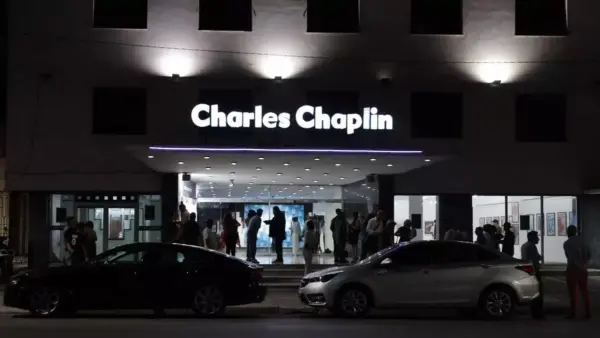
The program is extensive, but the premieres that once defined the event’s history no longer arrive.
HAVANA TIMES – Havana once again rolls out its red carpet, from this Thursday until Sunday the 14th, to inaugurate the 46th edition of the Festival of New Latin American Cinema, an event that was once synonymous with prestigious premieres and that today survives amid nostalgia, energy precarity, and an increasingly eroded reputation.
Despite official enthusiasm, the festival unfolds in a harsh context. The massive blackout on Wednesday left the entire western half of the country in darkness, and no one can guarantee it won’t happen again.
This year’s lineup is broad—more than two hundred works from 42 countries—but that volume should not be mistaken for vitality. The festival lost its status as a launchpad for the continent’s major productions long ago. No longer do the premieres of filmmakers who once shaped the festival’s history—or the names that accompanied the rise of Latin American cinema—arrive in Havana.
In past decades, audiences took their seats expecting to discover new proposals by Fernando Birri, Glauber Rocha, or Arturo Ripstein, and to witness the birth of films destined to travel the world. Today, by contrast, many of the films screened in Havana have already been shown in Berlin, Cannes, San Sebastián, or Mar del Plata before reaching a capital where nearly all cultural infrastructure is on the verge of collapse.
The selection includes titles of international stature with works by Latin American filmmakers who have gained recognition over the last decade, alongside European–Latin American co-productions seeking to raise the artistic level of the event. This international opening is not a misstep—many filmmakers have demanded it for years—but it highlights the distance between the contemporary festival and its founding mission, a mission it had long failed to fulfill.
Within the Cuban sphere, the harvest is modest but not nonexistent. Among the fiction feature films, there is particular curiosity surrounding Neurótica anónima, directed by Jorge Perugorría and Mirta Ibarra, which returns to urban and emotional themes from a contemporary perspective. The documentary Tiempo detenido, by Ariagna Fajardo, stands out within national production by exploring, with minimal resources, the suspended life of a country accustomed to stagnation.
Among the short fiction films, notable works include Pupa, by Leandro de la Rosa; Norheimsund, by Ana Alpízar; and Primera enseñanza, made by Aria Sanchez and the Brazilian director Marina Meira, who won the Best Director award in the short film category at the Doha Film Festival. These works compete alongside titles from Chile, Argentina, Mexico, Colombia, and Brazil in a category historically vital for measuring the pulse of emerging Latin American cinema.
But no selection, no matter how solid, can conceal the decline that surrounds the festival. The loss of relevance is not due solely to the uneven quality of the films, but also to the inability of the country’s cultural infrastructure to sustain an event of this magnitude. Last year, several screenings were suspended due to sudden blackouts; the much-anticipated Matar a un hombre, by Cuban filmmaker Orlando Mora Cabrera, lost two screenings due to lack of electricity—though the director denounced it as a disguised form of censorship. This Wednesday, another massive blackout reminded everyone that electrical power—the minimum condition for projecting a film—is not even guaranteed for one of the nation’s most emblematic cultural events.
The specter of censorship is another guest that never misses the occasion. The exclusion of the documentary Para vivir. El implacable tiempo de Pablo Milanés, directed by Fabien Pisani, was one of the most discussed decisions in the festival’s lead-up.
The film, which recounts the artistic and emotional life of the troubadour—from his formation in the Nueva Trova movement to his increasingly critical stance toward power—had sparked considerable anticipation inside and outside Cuba. However, it never appeared in the official program. Its absence does not surprise those familiar with the country’s cultural limits: Milanés, one of the most beloved voices in Cuban music, also became a politically uncomfortable figure. The veto of the documentary confirms that censorship remains an invisible wall that neither cinephile enthusiasm nor festival tradition can break through.
The public’s relationship with the festival has also changed. In its best years, the event would fill theaters from early morning until after midnight. Today, audiences still attend, yes, but without the cinephile anxiety that once defined them. The absence of major premieres, the deterioration of cinemas, intermittent censorship, epidemics, shortages in public transport, inflation, and the wear and tear of daily life have all reduced enthusiasm. What was once a celebration is now an effort.
Even so, the festival persists, sustained by the conviction of filmmakers who still believe in it and by an audience that, although battered, hopes to forget the outside reality for a few hours. Habaneros may try to “forget the chikungunya,” as Rafael Grillo suggested in El Caimán Barbudo, but what truly proves impossible to ignore are the blackouts. Because without electricity there is no cinema, and without cinema there is no festival.
First published by 14ymedio and translated and posted in English by Havana Times.