
Venezuela: Maduro is Gone, What’s Next?
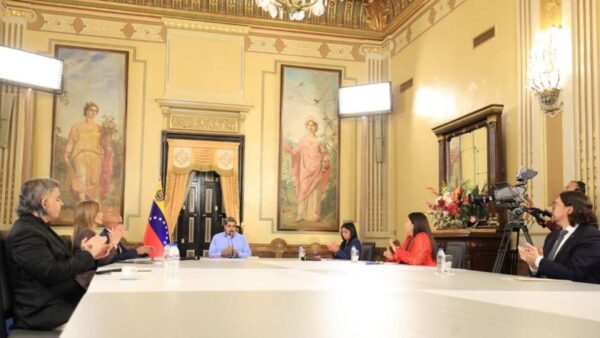
The capture of Nicolas Maduro by the United States on January 3rd has revived the debate over a possible successor. The range of options goes from opting not to declare an absolute absence, to not recognizing his legitimacy due to usurpation of office after losing the July 2024 elections, and moving toward a transition, to settling the competing ambitions within his own party: the PSUV.
HAVANA TIMES – The early-morning bombings not only woke Venezuelans with concerns about their safety but also brought with them the uncertainty of who will succeed Nicolas Maduro.
Maduro will be unable to exercise his office since he was captured by US authorities. In addition to being accused of several crimes such as narco-terrorism, possession of weapons, and importation of cocaine, among others.
The question—Who will succeed Nicolás Maduro?—has no easy or single answer.
Everything will depend on how the Constitution is interpreted, on whether he usurped power and since when, as well as on overcoming the obstacles posed by the ambitions of prominent figures within the PSUV (United Socialist Party of Venezuela) and the decisions taken by opposition leaders aligned with Maria Corina Machado, with the backing of US President Donald Trump.
Venezuela’s Constitution does not include, among its provisions, declaring an absolute vacancy in the event that a president is “removed, kidnapped, or detained by foreign forces.”
Article 233, states: “The absolute absences of the President shall be his death, resignation, or removal decreed by a judgment of the Supreme Court; his permanent physical or mental incapacity certified by a medical board appointed by the Supreme Court and approved by the National Assembly; abandonment of office, declared as such by the National Assembly; as well as the revocation of his mandate.”
Hence, several experts point out that none of these circumstances apply in Nicolás Maduro’s case.
Meanwhile, the Constitution indicates that situations arising from temporary vacancies shall be “filled by the Vice President for up to 90 days, extendable by decision of the National Assembly for up to an additional 90 days.”
Following the attacks on strategic sites in Venezuela and given Maduro’s arrest, it has been Defense Minister Vladimir Padrino Lopez—via a video—Interior Minister Diosdado Cabello, and Vice President Delcy Rodriguez—through a phone call to state television—who have taken charge of rejecting the attack by US military forces on national territory.
The problem
In December 2023, the issue of succession was a national debate. At that time, both political scientist Piero Trepiccione and Felix Seijas, director of the polling firm Delphos, stated that “succession becomes a problem.”
The problem lay in the PSUV’s very structure. Both interviewees agreed that Chavismo has a “vertical structure” and that the party is a “centralized” party in which a small leadership makes decisions—hence why succession became an issue.
But long before that, Chavez’s heir was considered to lack legitimacy of origin, given that the 2018 elections were deemed invalid.
In January 2019, when the elected president was supposed to assume office, constitutional lawyer Juan Carlos Apitz explained that the Legislative Branch was prevented from applying Article 233 of the Constitution due to the lack of legitimacy of the May 2018 elections, and that the correct thesis was to invoke the usurpation of office.
He argued for invoking Article 138: “any usurped authority is ineffective and its acts are null.”
In this scenario, some also argued that the correct course was to invoke Article 333, which establishes that, in the event of a constitutional rupture, “every citizen, whether vested with authority or not, has the duty to collaborate in restoring the constitutional order.”
At the time, Apitz stated that this was the route Parliament should follow.
Party ambitions
Another angle at play is party ambitions, and this difficulty carries over to the present moment.
While it is true that Delcy Rodríguez would be at the helm of the state, it is also true that figures who have at various times been mentioned as Maduro’s successors cannot be ignored.
The list of names includes, among others, Diosdado Cabello, the second most powerful figure in Chavismo; Delcy Rodríguez herself, whose name has surfaced at moments when a transition has been discussed; Rafael Ramirez, living in what has been described as a “golden exile” in Italy; and Jorge Rodriguez, president of Parliament.
A transition in accordance with the law
Maduro’s legitimacy as president is not only in doubt in Venezuela, but also internationally. In a statement, the European Union reiterated that Nicolás Maduro “lacks legitimacy” and advocated for a political transition, insisting that in any scenario international law and the United Nations Charter must be respected.
Lawyer and university professor Nelson Chitty La Roche said the Venezuelan situation is still unfolding, but he does not rule out that it will be Trump who sketches a transition route according to his own criteria. In this regard, he stated that the US president wants to reach an understanding with the military. “For that purpose, it is better to do so with Delcy Rodríguez than with María Corina Machado. Trump has not recognized Edmundo González.”
Chitty La Roche has no doubts that there is an absolute absence of the president. “Maduro is not here and will not be, although his illegitimacy of origin presents an unresolved problem of form and substance.”
For others, the successor should be Edmundo Gonzalez, who, according to the Venezuelan opposition, won the July 2024 elections with more than 7 million votes, and who is currently outside Venezuela.
At midday on January 3, a statement was released on Maria Corina Machado’s social media accounts asserting that she, together with González, is “prepared to take power.” It adds that Gonzalez should assume the presidency and be appointed commander-in-chief of the Armed Forces.
The corollary of the situation is that a group of heads of state and international organizations are calling for a peaceful and democratic way out for Venezuela.
First published in Spanish by Efecto Cocuyo and translated and posted in English by Havana Times.