
Venezuelan Majority Opposition Opts for Pragmatism
Call for new elections as long as they are free
“Our duty is to remain vigilant so that Venezuelans’ right to live in democracy becomes a reality,” says PUD secretary.
HAVANA TIMES – With Nicolas Maduro detained by US special forces to face “narco-terrorism” charges before the US judicial system, opposition figures—including Maria Corina Machado—demanded that Edmundo Gonzalez Urrutia, winner of the 2024 presidential election with over 67% of the votes, assume power.
But on that same January 3rd, during a press conference to publicly account for the operation that extracted the Maduro and his wife, Cilia Flores, President Trump dismissed that possibility outright. He said from Washington, Venezuela would be “governed,” by the US until an “orderly transition” is achieved.
Secretary of State Marco Rubio expanded on this: the goal is to stabilize the country economically and avoid chaos, hand-in-hand with chavismo still in power but without Maduro, maintaining institutional and military control. “Conditions are not in place,” Rubio argued, not even for new presidential elections in Venezuela in the short term.
Faced with imminent US tutelage—which the inner power circle at Miraflores (presidential palace) does not acknowledge, but toward which it shows significant signs of compliance—the majority opposition grouped under the Democratic Unitary Platform (PUD), which still recognizes Maria Corina Machado’s leadership, has decided to share her pragmatic position, as she does not confront Trump but thanks him and declares herself willing to compete electorally and win.
In this sense, the opposition coalition endorses a transition aimed at the definitive restoration of democracy in the country, one that includes the full release of all political prisoners and, if necessary, new presidential elections—without denying the victory of Edmundo Gonzalez in July 2024, and as long as the elections are free.
Transition Must Be Democratic
PUD executive secretary Roberto Enríquez warned, “An orderly transition is necessary. Now, the question is: a transition toward what? The obvious answer is toward democracy, peace, national unity, and respect for human rights. It is evident that we are at the dawn of a process of change, but the alarms must always be on; let us recall Lampedusa and his Leopard: beware of changing everything so that nothing changes. Our duty is to be vigilant so that the right of Venezuelans to live in democracy becomes a reality,”
In statements to Efecto Cocuyo, the Enriquez, the Copei party president, stressed that Edmundo Gonzalez won the 2024 election and that this is not up for debate, but that the opposition that backed him in those elections, through the unified MUD ballot position, will continue making efforts to restore democracy in Venezuela—leading to the evaluation of other avenues, including new elections.
“You can be sure that we will continue putting all our effort into making Venezuela democratic again; that is the only way to guarantee stability for this transition that is just beginning. Maria Corina Machado is the leader of the democratic cause, as was decided by the Venezuelan people on October 22, 2023, and the PUD was the coalition that organized that powerful and wonderful primary election,” added the former member of the opposition delegation during the Mexico negotiations.
In an interview with Fox News on January 6th, Machado reaffirmed her desire to return to the country as soon as possible and said that were new elections to be held in Venezuela, the opposition she leads would win with 90% of the vote. In a more recent interview with the digital outlet La Patilla (January 7th), she said that if even under fraudulent conditions Edmundo Gonzalez’s victory was so overwhelming in 2024 (67% of the vote), then in “clean and free” elections the triumph would be even more of a landslide.
She also called for “caution” when analyzing and speculating about US policy decisions toward Venezuela.
Between What Is Desired and What Is Real
“Starting from the clear objective that almost all Venezuelans share—which is the restoration of our democratic system and freedom—we must evaluate the US government’s decision to work at this moment, transactionally and temporarily, with Delcy Rodriguez as an important and even logical step, given the absolute control that the regime has held for years over the entire state apparatus,” Adriana Pichardo, deputy political coordinator of Voluntad Popular, told Efecto Cocuyo.
The former lawmaker acknowledged that it would have been impossible to initiate a transition without having at the helm a figure capable of relying on the “apparatus,” even if that figure lacks popular support. For that reason, they understand that at this stage it is necessary to work from within the institutions to carry out the needed transformations.
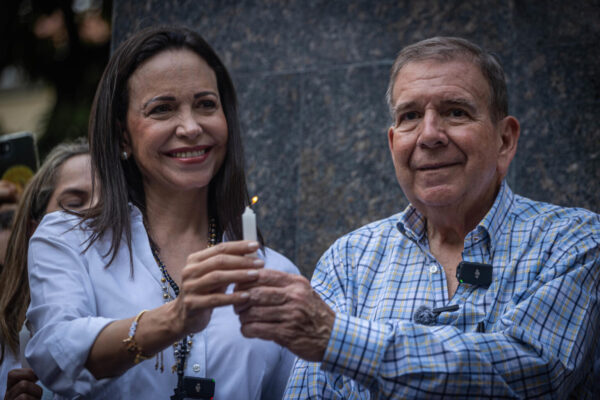
“Hearing that statement (by Trump about governing Venezuela until transition is achieved) obviously had a strong impact on every Venezuelan; however, in the end political expertise and common sense prevail, and we understand why that decision was made, knowing what Venezuelans have lived through,” Pichardo said.
One concern she raised is that the chavismo still in power does not inspire confidence, given that in past dialogue and negotiation processes it has broken agreements.
She fears that the power structure headed by Delcy and her brother Jorge Rodríguez might not be able—or might not want to—comply with the requirements necessary for real progress toward a transition that culminates in the country’s stabilization economically, socially, and politically, and later in the legitimacy conferred by transparent elections in which Venezuelans may freely express themselves.
Jorge Rodriguez, the president of the National Assembly, has also served as Maduro’s chief negotiator. The last agreement signed with the opposition Unitary Platform, signed by Rodriguez, was the Barbados accord, mediated by Norway. The government committed, among other things, to respect the results of the July 2024 elections—and did not. Maduro, with Delcy Rodriguez as vice president, remained in power an additional year sustained by military and police force, in a repressive framework that peaked at 2,000 detainees.
“On July 28, 2024, the people spoke clearly in favor of Edmundo Gonzalez; there are tangible results backed by tally sheets, something the regime could not show. However, we understand the dynamics, and if new general elections are necessary to enable the re-institutionalization of the country, we believe that is an important alternative. We know María Corina and Edmundo are fully aware that this is a possible scenario that could yield good results and one to which we are not afraid, as long as conditions exist for real elections to take place in Venezuela,” Pichardo emphasized.
Reposition and Move Forward
Leaders of the Accion Democrática and Causa R parties likewise agree that new elections, in an undefined timeframe, are the most likely scenario, after meeting conditions such as the release of political prisoners and the formation of a new National Electoral Council (CNE).
“We are already on a path in which for the moment we are only spectators. It didn’t happen that Edmundo Gonzalez assumed power because Maduro decided to stay by force; sometimes things do not happen as one wishes, but we cannot get stuck there. Respect for the popular will must always be a demand, but now we must move forward and continue evaluating events. We must also remember that coercive power remains in the hands of chavismo,” said former lawmaker and Accion Democrática member Freddy Valera.
The former member of the Bolivar state Legislative Council clarified that it is not just a matter of demanding sovereignty vis-à-vis the US, without forgetting that Miraflores has also violated that concept by bringing its external allies (Russia, China, Iran, Cuba) into the country to bolster its repressive apparatus and benefit economically. Nor, he stressed, did Maduro and his circle respect the popular sovereignty enshrined in Article 5 of the Constitution.
“Political organizations must continue demanding the release of all political prisoners, analyze the terrain we are walking on with many limitations, and support the search for solutions, especially economic ones, as the most urgent to provide people with relief. We remain coordinated with Maria Corina Machado and other national actors,” Valera told Efecto Cocuyo.
No More Repression or Political Prisoners
After demanding power for Edmundo Gonzalez based on a majority decision in the 2024 elections, Causa R leader Andres Velasquez also softened his stance somewhat and declared his support for the transitional process toward a free and democratic Venezuela, “free of human rights violators” and with full rule of law.
“Advancing toward that objective entails the release of all political prisoners and the dismantling of the tyranny’s repressive apparatus. It requires beginning the restructuring of institutions that lie in ruins, such as the National Electoral Council, necessary for new elections to be called,” he wrote on social media.
From within the Democratic Unitary Platform (PUD)—which is made up of AD, VP, Copei, Causa R, Convergencia, Proyecto Venezuela, Encuentro Ciudadano, and Primero Justicia (PJ)—leaders say coordination continues with Machado and Gonzalez, with ongoing evaluation of fast-moving developments since Maduro’s capture.
In recent days, Trump has spoken of an energy agreement with the interim government consisting of selling 30 to 50 million barrels of oil to the US and having Washington administer the revenues to invest in the Venezuelan oil industry and the rescue of the electrical system; release of political prisoners; and the possible return of the US embassy to Caracas.
Jorge Rodríguez announced releases, but political parties, human-rights NGOs, and relatives have denounced that only a small number of people out of more than 800 have been freed, among them attorney Rocío San Miguel, Convergencia leader and former lawmaker Biagio Pilieri, and former presidential candidate and former CNE vice president Enrique Marquez.
Trump revealed that a second military attack in Venezuela was canceled due to the “cooperation” of the interim government, but that the military deployment in the Caribbean—now nearing its fifth month—remains in place.
“If this process (the transition) is truly not to be a fiasco, the first steps must be a total end to repression, the release of all political prisoners, and the return of exiles with full guarantees,” Enriquez stressed.
Coordination with the Leadership
Un Nuevo Tiempo (UNT), which no longer forms part of the PUD and currently has representation in the National Assembly, has joined in the demand for the release of all political prisoners and for the transition to culminate in democratic elections, in addition to the renewal of all Public Powers.
“The opposition political alliance—truly opposition and democratic actors in Venezuela—remain in contact with the political leader María Corina Machado, understanding the position she must assume at this moment, with a great deal of pragmatism and political maturity, understanding the moment we’re living in and trying not to be an obstacle for the transition to move forward and end in an electoral process. There is much to be done: coordination, communication, and ongoing evaluation are part of the fundamental tasks,” added Pichardo.
On January 8, in an interview with host Sean Hannity on Fox News, Trump spoke of a possible meeting with Machado next (this) week in Washington, D.C.
“I understand that she will come sometime next week, and I am eager to greet her,” said Trump about the opposition leader whom he appears, for now, to have left outside the political transition in Venezuela.
First published in Spanish by Efecto Cocuyo and translated and posted in English by Havana Times.