
What Amnesty International Says About Venezuela
Condemns the aggression by USA and the crimes of Venezuela’s gov.
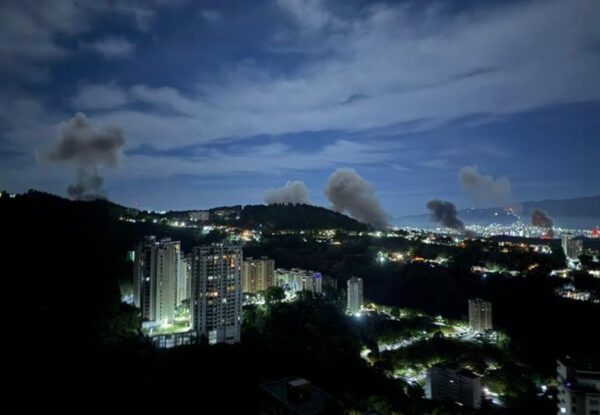
HAVANA TIMES – The United States’ attack against Venezuela on January 3 constituted an illegal use of force, while the crimes committed by the Venezuelan government against its own people continue without justice or guarantees of non-repetition, the humanitarian organization Amnesty International said on February 4th.
“Let us be clear: Amnesty International unequivocally condemns both the unlawful use of force by the United States and the multiple crimes committed by the Venezuelan authorities against the people of Venezuela,” said Agnès Callamard, the organization’s secretary general.
The United States carried out a bloody attack on northern Venezuela on January 3, which caused close to a hundred deaths among Venezuelan and Cuban military personnel, and captured President Nicolás Maduro and his wife Cilia Flores, imprisoning them in a New York jail awaiting trial on various charges.
Callamard said the US military operation “constitutes a clear violation of the United Nations Charter. It is an act of aggression that endangers the civilian population and destroys the safeguards of international law.”
“The use of force by the Trump government was not only illegal, it could also encourage unlawful actions by other states and foreshadow similar actions by the United States in the future,” she added.
Amnesty recalled that US President Donald Trump himself has stated that control of resources and geopolitical power in the region were largely motives for the January 3 attack.
“Since then, he has openly claimed his authority to direct policy in Venezuela, even as the acting president, Delcy Rodriguez, maintains defiant rhetoric while cooperating with the United States,” Callamard observed.
But “denouncing the illegal military action of the United States must in no way overshadow the urgent need for accountability and reparations for the grave human rights violations and crimes against humanity committed by the Venezuelan government,” Callamard maintained.
Maduro has been the subject of a preliminary investigation by the International Criminal Court for alleged crimes against humanity during his government (2013–2026), and complaints in this regard against Venezuelan authorities continue to accumulate at the United Nations Human Rights Council.
Repression in Venezuela intensified after the protests that followed the July 2024 presidential election, in which the official result favored Maduro’s reelection, while tally sheets held by the opposition showed a 2-to-1 victory for opposition candidate Edmundo González, now exiled in Spain.
The post-election protests left at least 25 dead and more than 2,200 people detained. At the time of the US bombing there were about 1,000 people imprisoned in the country for political reasons, some in conditions of forced disappearance for months.
After the US attack, a process of releasing those detainees began, under restricted freedom. The human rights organization Foro Penal, which monitors and supports political prisoners, has counted 350 releases to date, while 687 people in that condition remain behind bars.
Amnesty Int. recalled that in 2019 it established the existence of a widespread and systematic attack by Venezuelan authorities under Maduro’s mandate against the civilian population, concluding that crimes against humanity had been committed at least since 2014.
It stated that for years AI documented “the systematic policy of repression, which includes arbitrary detentions, forced disappearances, extrajudicial executions, torture and other ill-treatment, directed especially against human rights defenders, political opponents, demonstrators, journalists, and government critics.”
Callamard noted that “impunity for the crimes against humanity committed by Venezuelan authorities under Maduro’s mandate for more than a decade continues, up to now, under the acting government of Delcy Rodríguez.”
“Although some detained persons are being released, no significant steps have been taken to deliver justice nor have guarantees of non-repetition been provided,” she added.
On the other hand, according to Amnesty, threats to civil society space persist—various laws restrict its activity—and human rights defenders and their organizations continue to face the risk of persecution and criminalization.
At the same time, changes are occurring in oil legislation to grant concessions to US transnationals over the country’s resource. The population remains watchful regarding possible improvements in the economy and living conditions, which have deteriorated severely over the past decade.
A grave precedent
In its statement, Amnesty insisted that the United States, with its violent incursion of January 3, “is setting a grave precedent” beyond Venezuela.
It recalled that since taking that measure, President Trump has stated that he does not consider himself bound by international law and that the Western Hemisphere is a region the United States has the right to control, even with armed force, as it sees fit.
Callamard said that “it is not the first time the United States has resorted to the unilateral use of force, but it may be the first time it has attempted to justify its actions in a way that flagrantly contravenes the principles of international law.”
In this regard she finally warned that “today’s silence will be tomorrow’s permission,” and therefore “states must draw a clear line, here and now.”
First published by IPS in Spanish and translated and posted in English by Havana Times.