Gasoline Reaches 750 Pesos ($1.50 USD) per Liter in Havana
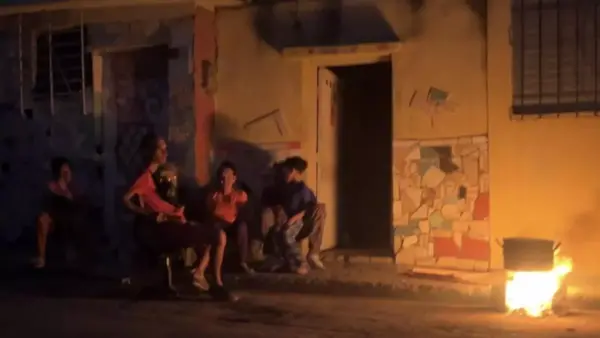
A tanker headed to Cuba from Africa, will now go to the Dominican Republic instead. Pots and pans are heard clattering in Havana protesting blackouts lasting up to 13 hours.
HAVANA TIMES – Cuba’s capital lived through a grim Thursday—literally. Diana, a second-year veterinary student in Havana, spent the entire day without eating. There is no gas left in her house, where she lives with her grandparents—both elderly—she told 14ymedio.
“They say people banged pots. I didn’t have the strength to hear it or to bang a saucepan myself, but I certainly felt like it,” says the young woman. “On top of that, I had an exam today, hungry, because there comes a point when bread doesn’t fill you, and it’s not cheap either.” She laments: “I don’t know where this is going, but I’m tired.”
Irma, a 40-year-old Facebook ad promoter, lists her ordeal: “The power goes out and the connection disappears. I caught a cold going out on the balcony looking for a signal and hanging clothes at night, because the laundry piles up, and when the power comes back it’s run, wash, cook rice, iron the kid’s uniform.” She says her sister, a seamstress, is tearing her hair out because she can’t get power to work. “They give her electricity for one hour the entire day—if this keeps up, she’ll have to sleep during the day and work at night. And the worst part is it seems that you-know-who doesn’t care.”
“People here live however they can. Many skip meals and baths, they resign themselves,” says a resident of Guanabacoa. “Yesterday pots and pans were banging loud in several areas here. We’ll have to see what happens when the heat arrives, and on top of everything there’s the lack of sleep.”
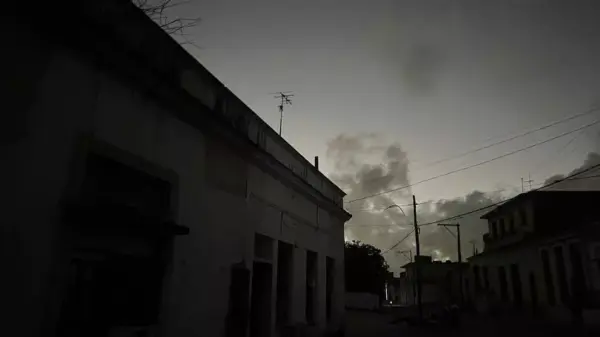
At night, the streets are lit by candles where people cook at their doorways, or by the ember of a cigarette. Some neighbors take it with as much humor as they can. “I have no power, I have no soap,” sings a young woman to a Juan Gabriel melody, continuing: “I have no money and nothing to give.”
Several Havana municipalities reported more than nine hours without power, like in Marianao, where the electricity was cut at 3 p.m. and by midnight had not returned. In La Güinera, in Arroyo Naranjo, residents denounced up to 13 hours without electricity, and in La Lisa there were pot-banging protests. “I just confirmed via video call that the power came back a few minutes after the demonstration… so, for those who understand, you get it,” said journalist Mario Pentón.
Mercedes and Antonio, two retirees who live alone, had to cook peas at 11 p.m. on Tuesday, when power finally returned after 14 hours. “It was enough to drive you crazy,” says the man, who worked as an accountant—his wife was a doctor. However, “Wednesday’s blackout was even worse.”
Fuel shortages are also evident at gas stations. Since January 10, the Ticket system has not provided the list of the 24 stations open in the eastern sector of Havana, which could indicate that they are all closed. It still provides the list for the western sector: this Thursday, only 5 of the 14 stations there remained open.
Meanwhile, on the informal market fuel prices are skyrocketing. In Holguín, local sources report gasoline at 1,200 pesos per liter and a can of kerosene for up to 15,000. In Havana, some users say they can find gasoline “on the side” for 1,000 pesos per liter, although in most places the going rate is 700 to 750. In Sancti Spíritus, the cheapest prices are found: five liters of “stove kerosene,” explains a neighbor, cost between 1,850 and 1,900 pesos—that is, between 370 and 380 pesos per liter. Most monthly pensions in Cuba are under 4,000 pesos ($8 USD) and the average salary is a little over 6,000 pesos ($12 USD).
The situation is not improving and the ship on the horizon is fading. In a strange turn of events, the Mia Grace, the tanker headed to Cuba from Togo to deliver 314,500 barrels of diesel or 280,500 of fuel oil—according to University of Texas expert Jorge Piñón—has changed course. Geolocation data this week showing it departing the port of Lomé with scheduled arrival in Havana on February 4 have been updated.
The ship, sailing under the Marshall Islands flag, now appears off the coast of Guinea after departing Takoradi (Ghana) on January 13 with destination Río Haina (Dominican Republic), where it is expected February 2. It is unknown why it changed the route detected last Monday by Piñón, who alerted 14ymedio about the tanker’s destination and said it could be a “cash sale” by the state-owned Cubametales—sanctioned by the US—“through a European intermediary.”
The expert noted that “Togo does not refine oil, but it exports refined oil and has extensive maritime logistics and transit infrastructure.” Now, the origin points to a port in Ghana, roughly 500 kilometers from Lomé.
Ghana’s oil industry has grown considerably in recent years along with gold, though it remains a mid-level African crude producer, especially compared to Libya, Nigeria, or Algeria. The latter, which maintains excellent relations with Cuba, has provided a small quantity of oil to the Island—only around two million barrels annually, equivalent to 18 days of national consumption.
Cuba’s thermoelectric plants are going in and out of operation as if spending the day inside a revolving door. On Thursday, the electric company’s posts announcing shutdowns were so numerous that users had enough. “All those shutdowns go straight to the people—thanks so much for your efficiency,” one replied bitterly. The “offline” and “back online” announcements multiplied, prompting joking comments amid the despair. “Whoever runs the UNE profile must enjoy their job—they work more than anyone else at the company. The level of incompetence is unbelievable,” wrote another.
The most significant point is that since this week UNE, the State electric company, has stopped reporting the deficit by energy type. This Friday’s details indicate breakdowns in units 5 and 8 of CTE Mariel, unit 3 of CTE Carlos Manuel de Céspedes, units 5 and 6 in Nuevitas, and unit 2 of CTE Felton. Meanwhile, unit 2 of CTE Santa Cruz del Norte and unit 4 of CTE Carlos Manuel are under maintenance—466 MW offline from thermal generation. But the data on fuel-related shortages—provided for months and typically exceeding 1,000 MW—is now completely absent.
First published in Spanish by 14ymedio and translated and posted in English by Havana Times.