
Russian Consortium to Enter Rice Production in Cuba
Following in the footsteps of Vietnamese companies
A processing plant in Artemisa also signs an agreement with an Italian company to produce coffee for export.
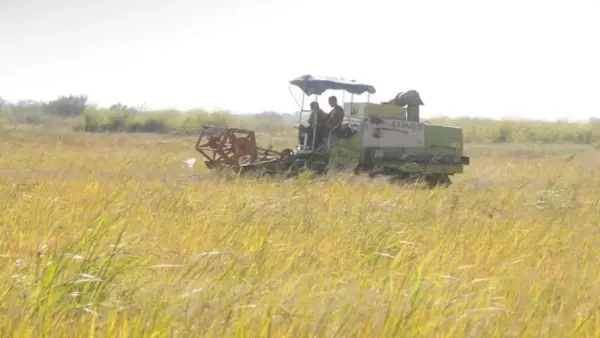
HAVANA TIMES – The state-owned company Agroind S.A. has reached an agreement with the Russian Rice Consortium to, “help Cuba achieve food sovereignty.” The project, presented during the recent Havana International Fair (Fihav 2025), aims to achieve yields of more than six tons per hectare, starting with 600 hectares planted in the municipality of La Sierpe, in Sancti Spíritus.
The intention is to expand production to 10,000 hectares, which would mean an efficiency similar to that of Vietnam, Thailand, or China. For this, the Russian consortium will have to provide the necessary inputs.
It is noteworthy, however, that the Russians are following in the footsteps of the Vietnamese on the Island when it comes to production of this grain. Earlier this year, a company from Vietnam became the first foreign entity to receive land in Cuba—initially 308 hectares—to plant rice on a farm in the southern part of Pinar del Río province, an unprecedented experience on the Island since 1959.
This gave rise to a rice-production experiment with Vietnamese participation, in which the Vietnamese supplies the hybrid seed, inputs, and technical advice, while Cuban usufruct farmers handle the planting and harvesting.
With results far above the yields of local producers, they achieved around seven tons per hectare compared to the country’s average of barely 1.5 tons, demonstrating once again that the State is unable to drive a self-sufficient national production and that, to produce rice (or almost anything) in Cuba, it continues to depend on someone from abroad.
It was not the first time Vietnam had cooperated with Cuba in rice production. It had already done so in the same municipality of La Sierpe, in Sancti Spíritus, until 2022, when it decided to cancel the project, tired of Cuban inefficiency. In 2025, the Vietnamese technicians returned, only to encounter the same bureaucratic problems and fuel shortages that had caused their departure. The Russians will likely run into the same obstacles.
Nationa rice production barely reached 80,000 tons in 2024, while approximately 700,000 tons of rice per year are needed to cover domestic consumption. The remainder is supplied through imports.
The rice agreement with the Russian consortium joins others announced with great fanfare by the regime in an effort to boost a lackluster Havana Trade Fair (Fihav). Another such agreement was signed by the Luis Bocourt Coffee Processor in Bahia Honda, Artemisa, and the Italian company Caffè Sun, which plans to allocate 20 hectares supposedly to “position Cuban coffee in the international market.”
During the announcement of the pact, it was reported that the Island will provide “soil, climate, seeds, and experience in cultivation,” while the Italian side will supply “inputs, technologies, machinery, and financing” in order, according to authorities, to promote the production and commercialization of coffee. Renato Severini, a partner of the Italian firm, said he hopes to achieve “international recognition for Cuban coffee.” But no goals or production targets were announced regarding the beans.
Caffè Sun SRL operates mainly in Italy and distributes in other countries such as the US, Ukraine, Germany, and Spain. Now, Cuba is added to this map, but following the route set by the Government in this sector: export, rather than domestic consumption.
The agreement will not help Cubans regain their traditional “little sip” of coffee, much less bring the beans back to the ration stores or lower its exorbitant price on the informal market, since the main reason it does not reach the population is the collapse in production, which, according to the National Office of Statistics and Information, fell 51% over the past five years.
This is not the first attempt of its kind. Other earlier projects with foreign funding have supplied inputs to producers, and with leftover quantities destined for domestic consumption, packages of 250 and 500 grams, and one kilogram, have been produced to sell to the population “at affordable prices.”
One of them is MásCafé, an initiative of the Italian Agency for Cooperation and Development that began in 2023. According to Cuba News Agency last January, the initiative is being implemented in Santiago de Cuba, Holguín, Guantanamo, and Granma, and has provided producers with “essential tools” such as machetes, files, wheelbarrows, sacks, chainsaws, tractors, and motorcycles for transportation.
Another initiative that same year was BioCuba Café S.A. The company emerged as the first joint venture of the Cuban Agroforestry System with the Italian Lavazza Foundation.
Michele Curto, the company’s director, promised at the time, during the agreement’s announcement, that “for every ton of coffee that leaves, the same amount must be guaranteed for Cubans. Exporting coffee is necessary to increase production of the grain in the country, and that way we will manage to have coffee for everyone.”
However, BioCuba Café has not achieved the expected results. “Last year’s target fulfillment was 32%,” Curto noted, though he promised to “almost double that figure” for 2025. For now, there is no data on this, and coffee remains absent from most Cuban tables.
First published in Spanish by 14ymedio and translated and posted in English by Havana Times.