
Cuba and the New Annexationism
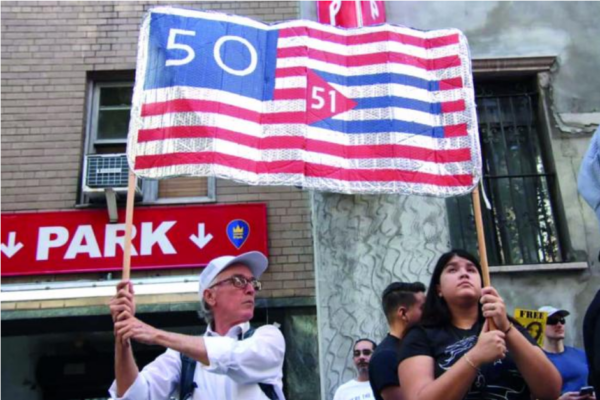
HAVANA TIMES — What happened this past January 3 between the United States and Venezuela has completely shaken Cuban public opinion, especially among those who are critical of this country’s establishment (probably a majority today of the Cuban population here, with all its nuances).
It is about the resurgence of annexationism.
Annexationism is the set of political intentions that see the annexation of Cuba to the United States as the best outcome for our Caribbean country. This tendency was never the majority in Cuba or among its diaspora, but there was a time when it was very powerful. It is also the derogatory label used by the establishment to discredit any opposition.
I do not intend to present academic expertise or moral wisdom here. Not even my personal opinion as a citizen. I only wish to convey what is heard and perceived on Cuban streets, in the lines, among workers waiting for transportation from their workplaces, and what resonates on social media.
Two emerging trends can be noticed, which previously did not enjoy broad popularity or prestige.
A large number of people are enthusiastic about how Delta Force carried out the “extraction” of ruler Maduro — and there is broad consensus (also reproduced quietly by representatives of officialdom, and by experts from countries such as Russia) that there was clearly a prior arrangement with certain high-ranking Venezuelan officials regarding the operation (the word “betrayal” is used a lot). And it is now practically clear to the entire Cuban people, to audiences of all mass media, that major transformations are underway Venezuela, even though the Cuban official media remain completely silent about it.
In the January 3 operation there was no intervention by large bodies of U.S. troops on Venezuelan territory, but Cuba was struck by the death of more than 30 personnel from Cuban armed institutions, and there is a painful effect for those of us who live here due to the cessation of oil supplies. Meanwhile, the Venezuelan government decided to close the emblematic and sinister Helicoide, the prison where political opponents were confined, and decreed a broad amnesty for those imprisoned on what were also considered political charges. Of this, the Cuban official media say nothing.
Many people here explicitly express their desire for the United States to mount a similar operation in Cuba. Even people I would never have suspected of holding such a position. This shows the magnitude of the economic, social, and lived collapse that Cuba is experiencing.
Ideologically, however, it is surprising that suddenly there is so much faith in a “supreme savior” arriving “from outside.” Apparently, we have been a people of patriots since the early nineteenth century, and it has not only been official propaganda that has promoted that discourse among the “masses.”
Annexationism is another trend that is appearing — even harsher — and for many people it is a ridiculous absurdity.
There is a petition on the digital social-causes platform Change.org where more than 10,000 people have expressed support for such an option. It can also be seen in social media comments.
A distinction must be made: it is one thing for workers — young and not so young — to comment while waiting for the bus from their workplace, saying “I’m not going to move a finger to keep this standing” (in itself a phrase that previously was not commonly heard in public); and another thing to say “I want Cuba to be part of the USA.”
The collapse being experienced, the precariousness of daily life, the degradation of national production — with the economic predominance of all kinds of retail businesses rather than industry, agriculture, or creative enterprises — has been convincing many people that only by becoming part of the United States could a way out of the crisis we are trying to inhabit be glimpsed.
Annexationism as a political current emerged in Cuba in the mid-nineteenth century, with figures such as Narciso Lopez, who designed the current Cuban flag. That flag was conceived for a US state, when people like Walt Whitman spoke of a North America united under the stars and stripes from Alaska and Canada down to Cuba. But unlike the bearded Walt, the elegant Narciso and his companions pursued a precise purpose: a slaveholding Cuba united with the Southern states — the future Confederacy, defeated in that country’s Civil War.
After that, few people know that the fathers of the Cuban nation, while debating the first independence constitution in 1869, also addressed the US government requesting annexation.
In subsequent decades, annexationism — which was never had majority support here — lost its roots, and although mediated, Cuba proclaimed its independence in 1902, albeit under US tutelage. US elites did not like the idea of having as a Union state a racially diverse country with an underdeveloped economy compared to that of what was then still an emerging world power.
The entire core discourse of the 1959 revolutionaries revolved around national independence. Even dissidents who emerged in the process embraced independence as a principle, even when they held other attitudes toward the United States.
There are those who believe that even now Cuba would not be admitted as a state, but they would settle for a Puerto Rico–style status: without real representation in Congress or the Executive, but with most of its population living within the US mainland, or at least able to travel there.
Now, many of the new annexationists seem to show particular blindness regarding the major crisis confronting the United States under the Trump government. They declare themselves MAGA even at times when ICE has deported some of them to Cuba or other countries.
But Cuba’s crisis is another matter: it is not only about violence and erosion of political institutions, but about surviving amid a true collapse.
We live in increasingly sinister times, and no one knows the future.
Much better to make a deal with a number of countries like Holland Canada and China than the United States