
Cuba: Without a Channel for Dissent, No Way Out of Crisis
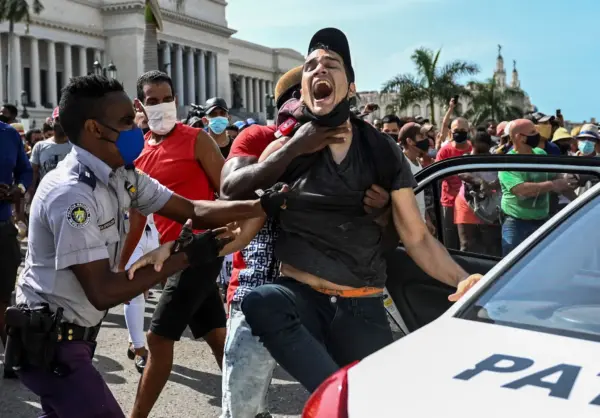
HAVANA TIMES – In any society, dissent serves the purpose of pointing out problems, questioning political decisions and holding those in power accountable. In today’s Cuba, managing the prolonged social and economic crisis demands that decisions be reviewed, errors corrected and channels of participation opened. However, any citizen criticism is treated as a threat instead of a legitimate citizen right. Such treatment only aggravates the existing tensions.
Cuba’s 2019 Constitution establishes: “The State recognizes, respects and guarantees freedom of thought, conscience and expression to all individuals.” Similarly, if affirms that “all people enjoy due process, as a guarantee of their legal security,” and, as such, cannot “be deprived of their freedom except by a competent authority and for the legally established period.” Finally, it states: “all persons have the freedom to enter, remain, cross, and leave the national territory.”
Nonetheless, the gap between that Constitutional framework and the reality of daily life is considerable. In practice, an expansive and arbitrary use of specific criminal and administrative terms such as “disobedience,” and the regulations tied to supposed national security interests have opened the way to levying punishment on behaviors that – in themselves – form part of the legitimate exercise of rights. The cases of recently detained entrepreneur William Sosa, or of historian Alexander Hall, forbidden to leave the country, confirm these assertions.
In the same way, the way the government has addressed the work of independent media outlet El Toque, and its ties to collaborators and entrepreneurs on the Island, has been highly questionable. From a democratic point of view, a media outlet has the same right to question the government, that the government has to point out any elements in the media outlet’s agenda that it considers intrusive or manipulative.
Legal actions against a media outlet can go forward only when the publication engages in conduct specified in the legal codes, such as the dissemination of fake news that causes verifiable harm; or acts of libel; or the violation of other rights recognized in the current legal system. Some countries also consider illegal the reception or utilization of funds from enemy foreign governments for the purpose of influencing internal political processes.
However, for said mechanisms to operate with legitimacy and efficiency, the existence of a State governed by the rule of law is essential, with a clear, coherent and guaranteed legal framework that protects freedom of expression and the press, including the exercise of independent journalism, not only State and public media. The absence of that framework – which the Cuban government has avoided establishing – limits the citizens’ possibilities of accessing effective legal resources and enjoying an environment of informational freedom.
Hence, publicly criticizing an entire team using terms like “media terrorism,” which have no basis in international treaties, ends up being more a police response to a political situation and an attempt at character assassination than a legitimate questioning of that media’s agenda.
On the other hand, it’s important to distinguish between criticism of the government and criticism of the country – a difference that has frequently been blurred in the Cuban political rhetoric. Questioning concrete decisions, pointing out errors in management, or demanding changes in public policies, are not equivalent to attacking the nation or wishing ill for Cuba; on the contrary, many of these criticisms stem precisely from concern for the collective welfare and the defense of the national interests.
The problem isn’t the existence of criminals dedicated to conducts that are really harmful, but the elasticity with which these can be interpreted when it’s a matter of expressions of disagreement with government decisions, criticism of leaders, or promoting peacefully intended citizen organization.
It is important to emphasize that restrictions on freedom of expression for reasons of public interest are not unique to Cuba. Various legal systems punish, for example, the disclosure of state secrets that could jeopardize security operations, or incitement to hatred and violence against certain groups.
However, these restrictions must be regulated by clear rules, and their application governed by due process. In contrast, when “national security” reasons are repeatedly invoked to restrict or punish expressions of citizen discontent that do not call for violence or cover up criminal activities, several problems associated with this distortion emerge.
First, the practice constrains a legitimate and essential citizen right to oversee public power. Further, it trivializes and vulgarizes the very concept of national security, causing it to be less associated with the protection of the country’s sovereignty and integrity than with the political protection of certain decisions or figures in the bureaucratic apparatus. Allowing the category of “national security” to become a wild card for delegitimizing any criticism ultimately erodes public confidence in the seriousness of the institutions that are supposed to protect it.
Likewise, a foreign government’s policies of hostility and aggression should not be used as a blank check to punish internal dissidence. The existence of an adverse external context doesn’t eliminate the national leadership’s responsibility for management of the economy, public services, social protection or transparency.
Cuba today is engulfed in a multidimensional crisis with visible effects that include food and medicine shortages, recurrent blackouts, unreliable public services, and a perceptible deterioration in the quality of life. Faced with this reality, you can’t demand of a people suffering so many daily deprivations that they not confront those who have the legal and political mandate to seek solutions. Attempting to silence that confrontation doesn’t eliminate the causes of the unhappiness nor does it make those suffering forget their discomfort.
The criminalization of dissent also has profound consequences on political and social dynamics. One of these is the rise of extremism and polarization. When moderate channels of expression and participation are blocked, the perception gains strength that only the most radical positions are capable of breaking the deadlock.
Another consequence is the gradual delegitimization of institutions themselves: if they are seen as responding to criticism with punishment rather than corrections or accountability, the idea that change and reform are possible within the existing framework is weakened.
Eliminating the political function of public dissent as a mechanism for holding decision-makers accountable is a breeding ground for them to take measures without thinking about their effect on citizens, or for those in power to manipulate public policies to their own advantage, with impunity.
A clear example of all this is the case of former Economy Minister Alejandro Gil. For years, various individuals —economists, journalists, citizens—warned on social networks and independent media sites about the risks and effects of certain economic decisions made under his mandate, which contributed to the deterioration of the population’s living conditions. However, these criticisms were dismissed or branded as aligned with “enemy agendas.” Only when the official authorities themselves made public investigations and accusations of alleged crimes and management errors was it finally recognized that grave problems existed in the economic leadership.

In conclusion, even from the perspective of preserving the existing hegemony, silencing dissent is counterproductive. No political project can be sustained indefinitely through coercion and discipline alone, especially in contexts of prolonged crisis. Legitimacy is renewed by the ability to incorporate criticism, correct failed decisions, and open spaces where people feel they can speak without fear of reprisals. When, instead, the natural contradictions of any society are met with criminalization or punishment, not only are those who dissent harmed, but the basis of consensus that allows any state to continue is undermined.
It is, therefore, essential that there be open and safe spaces for citizens to point out what has been done wrong, propose solutions, and confront—peacefully and respectfully—those in positions of power who are obstructing those solutions. This implies reviewing the expansive use of criminal and administrative measures against behaviors that should be protected by freedom of expression and demonstration; ensuring that limitations on freedoms respond to criteria of necessity and proportionality, and not to the desire to punish dissent; and strengthening accountability mechanisms, so that criticism is not perceived as a threat, but as a normal component of public life.
Dissent is a basic element in any project that aspires to be democratic, inclusive, and sustainable. It allows for control of bureaucracy, highlights mistakes, corrects course, and prevents decisions made by those in power from completely disregarding the well-being of citizens. Criminalizing this right not only violates what is recognized in the Constitution itself, but also exacerbates the crisis by closing avenues for dialogue and reform. Preventing people from expressing their discontent will not make them stop feeling it.
The solution is not punitive, it is political, and it involves recognizing the essential role of criticism and guaranteeing safe mechanisms for citizens to exercise it without fear or punishment. Only in a context of real guarantees for dissent will it be possible for the different voices of society to contribute to a way out of the crisis. On the contrary, continuing down the path of criminalization moves us further away from any peaceful solution to the conflict, which, far from diminishing, grows with each person prevented from exercising their legitimate right to disagree.
First published in Spanish by Joven Cuba and translated and posted in English by Havana Times.
Repressive Governments (Such as the Cuban Regime) do not wish for their people to be in a position to freely express their true feelings, so they arrest anyone who they deem to be a threat to their system of Government, however people will still fight for the right to be able to express themselves no matter what, even if it means being arrested and sent to prison for expressing their beliefs! Keep strong people of Cuba for the day of judgement for the repressive government will surely come!