
Tension in Venezuela: What Happens in Cuba if Maduro Falls?
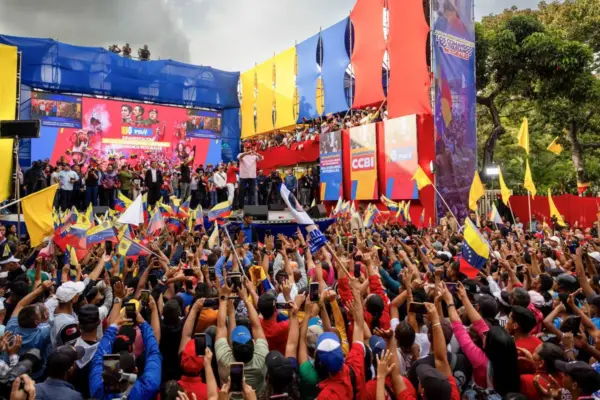
Since Hugo Chavez inaugurated the era of subsidized oil and ideological embraces, Venezuela has been the external lifeline of Castroism.
By Yoani Sanchez (Confidencial)
HAVANA TIMES – The question circulates on Cuba’s streets with the same persistence as the blackouts: “And if Maduro falls, what awaits us?” It is a recurring concern whenever Miraflores faces trouble, and in recent days it has flared up again in street-corner conversations, in lines, and in shared taxis.
From Havana, people look toward Caracas the way someone watches a wall that holds up part of their own house: any crack on the other side of the Caribbean threatens to bring down the structure on this shore.
For more than two decades, ever since Hugo Chávez inaugurated a new era of subsidized oil and ideological embrace, Venezuela has been the external lung of Castroism. Under Nicolás Maduro, that bond has remained. For the Cuban leadership, Chavismo has not only been a fuel pump; it has also been diplomatic backing, a loyal spokesperson in international bodies, and an ally willing to repeat—without shifting tone—the anti-imperialist resistance narrative to which Havana’s ruling elite clings.
Now that Washington’s noose tightens around Maduro, it is worth analyzing Venezuela’s real weight in sustaining the Cuban regime. At this point, some nuance is needed: Cuba’s petroleum dependence on Venezuerla is no longer what it was in the early 2000s. In recent years, Mexican oil and Russian shipments have gradually filled the gap left by a depleted PDVSA, unable to maintain its old supply levels.
An important piece
Havana has been forced to diversify because Caracas simply can’t give away what it no longer has. But even in its decline, Venezuela remains an important piece—not only for the oil that still arrives, but also for the political support and intelligence-sharing network it has provided the Island for years.
The Cuban government has also constructed a narrative in which Maduro’s survival is, in some sense, proof of its own resilience. The collapse of the Caracas regime would send a devastating message: the model of 21st-century socialism has completely fallen apart. Losing Miraflores would deepen Havana’s isolation and curb its ideological influence in Latin America.
Does that mean a political shift in Venezuela would automatically trigger a democratic opening in Cuba? History suggests caution. When the Soviet Union collapsed in 1991, predictions of an imminent end to Castroism multiplied. Yet the country did not open to political pluralism. Instead, it plunged into the crisis of the Special Period, intensified repression, and adopted limited economic pragmatism that allowed the regime to survive without transforming. Rather than democratizing, Havana’s Revolution Square dug in.
More hardship and more repression
If Maduro is toppled, the Cuban regime will face unprecedented pressure in this century. It would lose international backing, shrink its diplomatic maneuvering room, and perhaps be forced into deeper economic reforms. But pressure is not the same as change. Cuba’s ruling elite has shown an almost infinite capacity to postpone the inevitable. And though historical cycles seem to be accelerating across Latin America, in Cuba the official clock ticks at the pace set by a group of ninety-year-olds.
If Maduro is captured or flees, Cuba will—at least in the short term—sink into greater economic hardship: less oil, fewer hard-currency inflows, and more social tension. Havana will seek to replace what it loses in Caracas through new alliances—Moscow, Mexico, perhaps Algeria or Iran—and through heavier extraction from its own citizens: higher fees, more taxes, recycled dual-currency mechanisms. We will also see increased repression, as every external crisis turns into domestic paranoia.
What will happen then? Most likely more of what we already know: adjustments, quiet negotiations, new oil suppliers, old slogans reused. In the medium term, the disappearance of Chavismo could weaken one of the symbolic pillars of Castroism: the idea that its project has regional heirs. A fallen Maduro is a shattered mirror. And regimes do not handle cracks in their mirrors well.
Published in Spanish by Confidencial and translated and posted in English by Havana Times.