
Forbidden to Celebrate: Silence in the Streets of Venezuela
After the capture of Nicolas Maduro
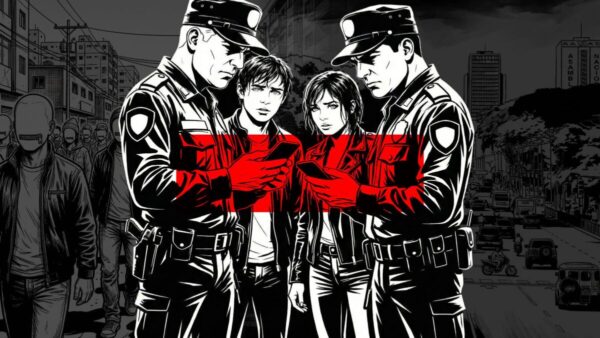
The capture of Maduro and Flores is not celebrated publicly in Venezuela. In an environment of rising repression and regulations that penalize any gesture interpreted as support, most people choose silence.
By La Hora de Venezuela (Efecto Cocuyo)
HAVANA TIMES – After the capture of Nicolás Maduro and Cilia Flores on January 3, 2026 by US forces, Venezuela showed a split reaction. While pro-government sectors mobilized their base to demand the release of whom they consider a “kidnapped president,” there were no recorded celebrations in the streets by opposition sectors, something that drew the attention of external observers.
This silence also contrasted with celebrations by Venezuelans living in various world capitals. Inside the country, however, there were no honking horns or large gatherings in public squares.
Far from signaling apathy or indifference, the absence of celebrations does not necessarily reflect rejection of Maduro’s capture, but rather a consolidated framework of repression, surveillance, and threats that reached a new peak following the implementation of a State of External Commotion decree after January 3, 2026.
The External Commotion Decree and the Silence of Dissent
Under the decree declaring a State of External Commotion, published in the Official Gazette, the persecution of any manifestation in favor of the US operation became the legal norm. The regulation authorizes the detention of individuals for acts interpreted as “promotion or support” of the capture of the Maduro-Flores couple, penalizing even symbolic gestures or minimal expressions.
Article 5 of the External Commotion Decree states: “The national, state, and municipal police agencies shall immediately undertake the search and capture throughout the national territory of all persons involved in the promotion or support of the armed attack by the United States of America against the territory of the Republic, for the purpose of placing them at the disposal of the Public Ministry and the criminal justice system for prosecution.”
In this context, the words “promotion or support” is broad enough to allow arrests for even minimal expressions of satisfaction over Maduro’s capture, whether on social media, in private chats, or public spaces.
Shortly after the decree’s approval, the first cases began to materialize.
In the state of Merida, two farmer brothers, aged 64 and 65, were detained in the rural locality of Río Negro after “celebrating” with gunshots into the air. According to Gonzalo Himiob, vice president of the NGO Foro Penal, the men were reported by pro-government neighbors after, “in a state of intoxication,” firing shotguns at the façade of their own house and making mocking comments.
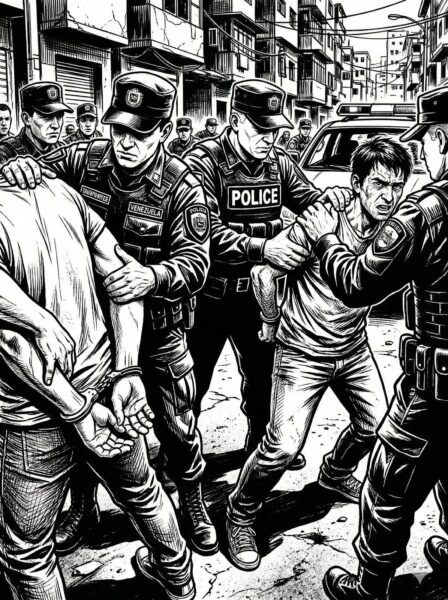
In Valencia, Carabobo state, officers from the La Isabelica Police Coordination Center arrested two men who, according to the authorities, were riding a motorcycle when they were accused of incitement to hatred, treason, and “promoting and supporting the attack by the United States against the Bolivarian Republic of Venezuela.” The police justified the procedure using the new decree.
“The note offers few details about the case and focuses mainly on justifying the arrest. It does not say, for example, where they were detained. It also does not say what they were doing,” reads a press note by El Carabobeño regarding the police report.
Relatives of the detained men in Carabobo denied the version published by the authorities on social media. Apparently, one of them was searched and, after authorities found a conversation on his phone about the situation in the country, he was forced to take officers to the home of the other young man, where both were detained, according to a report by El Pitazo.
Expressions on social media also led to the detention of Carlos Jose Guzman Armas, 40, in Puerto La Cruz, Anzoategui state, for sharing a TikTok video with comments directed at minister of interior Diosdado Cabello. According to local media, after the video circulated, security forces located and arrested him, placing him at the disposal of the Public Ministry on charges of incitement to hatred and disseminating destabilizing content.
On January 5, fifteen teenagers and eight adults were detained in Barcelona, Anzoategui state, while playing carnival in the “La Burra” sector. Officers from the Bolivarian National Police and the Bolívar Municipal Police carried out the arrest after responding to an anonymous call reporting supposed “terrorist acts” in the area. They were charged with incitement to hatred, treason, and criminal association. According to former prosecutor Zair Mundaray, the Bolívar Municipal Police accused them of “celebrating” Maduro’s detention.
According to the complaints, the youths were not allowed private legal defense, and officers allegedly planted evidence such as “stones and bottles they did not have.” After public pressure over the case, the teenagers were released in the early hours of January 13, although it remains unclear whether their release is full or conditional. The eight adults detained in the same operation remained imprisoned at the time of the releases.
Checkpoints, Searches, and Detentions
Following the US naval mobilization in the Caribbean, citizens reported the installation of irregular checkpoints at strategic points in several cities, especially Caracas. These reports not only reveal government practices of control and intimidation but also serve as alerts for others to avoid them.
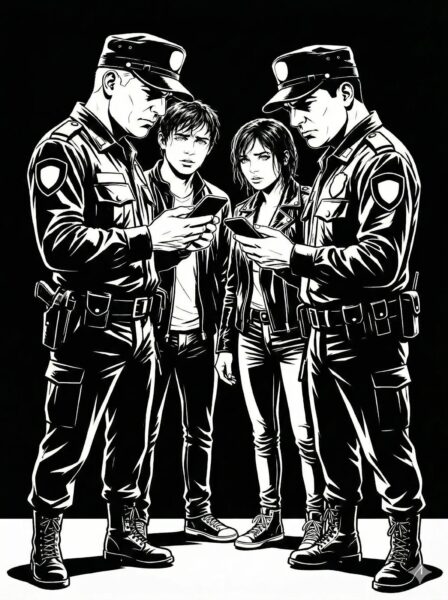
Several media outlets and NGOs have reported control operations in major thoroughfares of urban centers where military, police, and even alleged “collective” members stop vehicles and inspect mobile phones in search of sensitive or incriminating content.
In this context, Caleidoscopio Humano verified six cases of arbitrary detentions on January 5 and 6 in the states of Merida, La Guaira, Miranda, Bolívar, and Caracas. The individuals were released hours later, and only in two cases was the Bolivarian National Police identified as the acting body, while reports persist of armed civilians —so-called collectives— carrying out these checkpoint inspections.
“The reaction has been immediate. People have opted to go out without their mobile devices, preferring to leave them at home. Others have adopted an almost automatic routine: deleting chats every hour, removing photos, clearing histories, uninstalling apps, or avoiding any conversation that could be interpreted as sensitive,” noted El Pitazo.
This forced phone inspection has not been limited to civilians. On January 5, at least 14 journalists were detained while covering the installation of the National Assembly, where Delcy Rodríguez was sworn in as acting president. Although they were released hours later, during the detention they were subjected to interrogations, full phone inspections, and deletion of their recorded material.
International Repression
Persecution for celebrating Maduro’s capture has not been limited to Venezuelan territory. In Nicaragua, authorities arbitrarily detained dozens of people for expressing support on social media for Maduro’s capture, in a repressive campaign that has included warrantless arrests over posts, “likes,” or celebratory comments.
The Nicaraguan human rights organization Monitoreo Azul y Blanco denounced that at least 60 Nicaraguans were arbitrarily detained by the National Police for celebrating or expressing support on social media for Maduro’s capture.
“This new wave of repression is carried out without judicial orders and is based solely on expressions of opinion: social media comments, private celebrations, or simply not repeating the official propaganda. This constitutes a serious violation of human rights,” the organization stated.
The Weight of Collective Memory
Silence in the streets of Venezuela after Maduro’s capture cannot be explained as simple apathy; rather, it reflects the accumulated fear after years of repression, surveillance, and punishment of dissent. That silence is also sustained by a system of control that combines mass surveillance technologies, monitoring of social networks, state apps for denunciations, arbitrary inspections of mobile devices, and a legal framework that penalizes expressions contrary to official discourse.
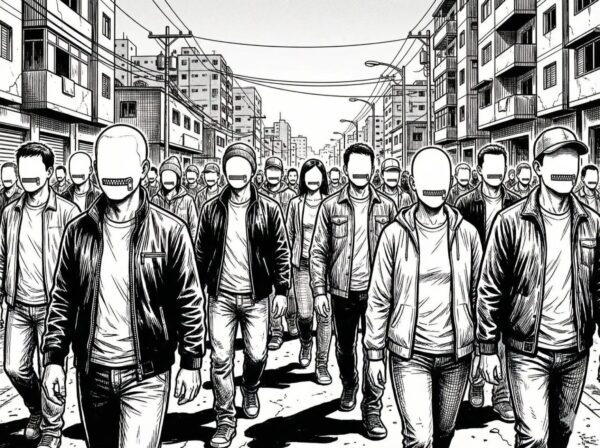
Emblematic cases such as that of Merlys Oropeza, a young woman sentenced to 10 years in prison for writing a critical message in a WhatsApp group —released in August 2025— engraved in the collective memory the consequences of even the smallest act of dissent.
On January 5, 2026, two days after the capture of Maduro and Cilia Flores, Foro Penal registered 806 political prisoners in Venezuela. After the so-called “Operation Absolute Resolution” and subsequent talks with the US government, on January 8 the government announced the release of a “significant” number of detainees. However, at the time of publication, several NGOs had only verified the release of 84 people, a reduced figure compared to the total registered cases and one that differs significantly from the figures reported by Delcy Rodríguez on Wednesday, January 14.
This control environment was cemented after the 2024 elections, when “Operation Tun Tun” evolved into an unprecedented digital persecution. Through coordination between pro-government neighbors and security forces, tools like the VenApp —originally designed to report failures in public services— became platforms for denunciations. This system institutionalized social surveillance and a robust infrastructure of technical monitoring, allowing even opinions in private messaging groups or social media statuses to lead to arbitrary detentions under charges of “incitement to hatred.”
When citizens internalize that any expression —even in the privacy of their homes or devices— may have severe consequences, including arbitrary detention and, in some cases, cruel treatment documented by human rights organizations, social control becomes automatic. This learned behavior, imposed through years of repression, helps explain why even at a historic moment the streets of Venezuela remained seemingly calm, with silence better understood as a strategy of survival than as a sign of apathy.
First published in Spanish by Efecto Cocuyo and translated and posted in English by Havana Times.