
Christmas Returns to Bethlehem After 2 Years of War in Gaza
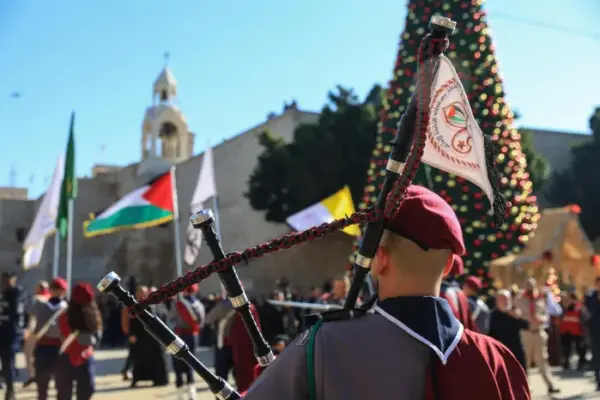
Since the start of Israel’s military offensive against Gaza, following Hamas’s deadly attacks of October 7, 2023, very few tourists have ventured to visit either Israel or Palestine.
By EFE (La Estrella de Panamá)
HAVANA TIMES — This Christmas Eve, the sound of bagpipes and drums was once again heard in Manger Square in the city of Bethlehem, separated from Jerusalem by an Israeli military checkpoint, as thousands of young Palestinians celebrated a Christmas that had been absent since 2023.
“This year, after two years of genocide in Gaza, we are celebrating here in Bethlehem as a matter of peace and hope, telling the world that we love life and want peace,” Palestinian Martinios Juha, a 20-year-old international relations student, tells EFE.
“For two years we’ve missed the Christmas spirit in Bethlehem, where Jesus was born,” he adds a few meters from the symbolic Basilica of the Nativity.
Around him, Christmas stalls offer boiled corn and cotton candy to children. In the center, thousands of Palestinian Boy Scouts march to the rhythm of music, while dozens of families cheer and applaud them in a square that is, nevertheless, practically empty.
Since the start of Israel’s military offensive against Gaza, following Hamas’s deadly attacks of October 7, 2023, very few tourists have dared to visit either Israel or Palestine.
And for most Palestinians, reaching Bethlehem itself is very difficult: they need an Israeli permit to travel and cross the mere nine kilometers separating the two cities.
Juha acknowledges that, for the first time in two years, he has an Israeli permit, valid for 40 days, during which he could visit Jerusalem until nightfall. However, he is not sure he will use it, given the climate of uncertainty and fear.
“Our celebration here is not joy. It’s a message of hope. The war (in Gaza) continues; the war has not ended. It’s a message of hope from Bethlehem, so that the world will remember us,” he reflects.
“People are freezing to death”
Like him, many people, despite the celebrations, continue to think about the Gaza Strip: plunged into a virtual ceasefire since October 10, but where Israeli troops remain deployed, attacking almost daily and bringing down buildings.
Although the famine that struck Gaza City before the summer—resulting in hundreds of deaths from malnutrition—has been reversed thanks to the entry of aid during the truce, UN Secretary-General António Guterres recalled five days ago that more than 75% of the population remains at risk of “extreme” food insecurity.
Colombian-born Sandra, of Palestinian origin, is even more graphic: “The situation is still not good because we think about the people living in Gaza, freezing to death (…) with tents flying away and exposed to the elements,” says the 68-year-old woman.
After the parade of bands and bagpipers, the highest representative of the Catholic Church in the Holy Land, Cardinal Pierbattista Pizzaballa, also made a plea for life in his Christmas address, urging Palestinians to celebrate despite everything.
“It is possible to celebrate in Gaza, it is possible to celebrate in Bethlehem. We need to celebrate not only today, but every day of the year,” added the prelate, who acknowledged that many problems remain.
Palestinian Tamer Gacamam tells EFE that his two children, aged 3 and 4, have never seen a similar Christmas celebration. Yesterday, Santa Claus visited the children’s school with gifts, which made them very happy.
“One day we want to visit the Holy Sepulchre with the children, but it’s a bit difficult,” he says, before adding that the children still do not know Jerusalem because, like adults, they need Israeli authorization to move around.
First published in Spanish by La Estrella de Panamá and translated and posted in English by Havana Times.