
Cuba: It Looks Like Artificial Intelligence
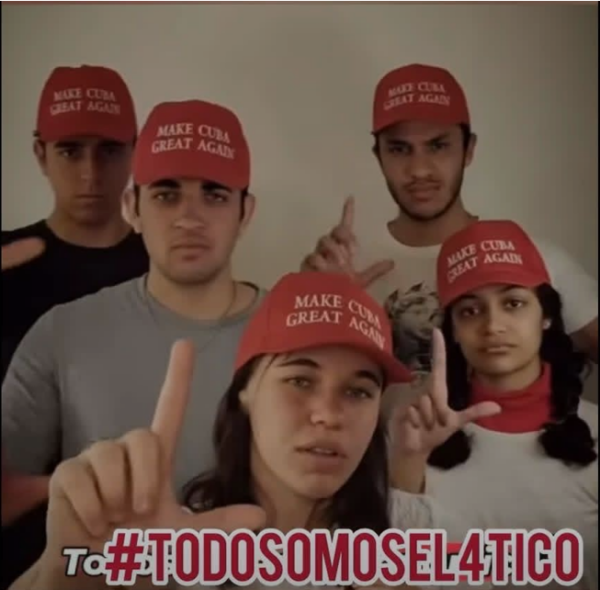
HAVANA TIMES — “It looks like Artificial Intelligence,” was the comment of a Democratic US American friend when he saw the photo of young Cubans wearing red MACA caps (Make Cuba Great Again). Certainly, when I saw the image, I instinctively felt a deep sense of strangeness. First I thought the caps were a collage, then that it had been done in Miami. Later I considered the possibility that the Cuban regime had created it with AI to discredit the internal opposition.
But in reality, the image contained a much more disturbing artificiality, whose projection almost bordered on cognitive dissonance. After nearly 70 years under the most recent and enduring dictatorship, young Cubans were alluding to a symbol that has become dogma of another authoritarian, quasi-fascist government. “Isms” almost always lead to a creed, a religion. The heralds of communism and capitalism preach dogmas that some follow fanatically; for others, the definitions of left and right are exchanged at convenience in an increasingly short-lived way.
Just to mention a few aspects: Donald Trump (once a member of the Democratic Party) is today a convicted president; he has supported the genocide in Gaza; he is responsible for freeing his followers who stormed the Capitol, resulting in the death of police officer Brian Sicknick. Two more recent deaths are those of citizens Renee Good and Alex Petrie, whose uniformed killers have yet to be judged. ICE, Trump’s personal army, has spread xenophobia and repression, deporting (including self-deportations) more than three million immigrants, including Cubans. His ambitions of global domination were already visible in Venezuela, and it seems Cuba and Greenland may follow.
Trump’s anti-intellectual stance has led some academics to declare him an idiot. His favorite author, Ayn Rand, erected a monument to selfishness, cementing the lack of empathy as a virtue. Trump is not an idiot, but he does know how to speak to idiots. While Castro sold humanist ideas, Trump promised economic well-being—pure materialism. Both are aligned with apparently opposing ideologies, yet equally abstract in their physical manifestation. The sociopathic traits of both point to an unrestrained megalomania. One at the head of a small island, the other leading an empire through executive orders.
Fidel Castro also had expansionist ambitions: Algeria, Congo, Ethiopia, Angola… He was criticized by many who today call for a military intervention in Cuba by a foreign power. Perhaps underdevelopment, as Edmundo Desnoes wrote, is the inability to relate things and accumulate experiences.
Despite the fact that Latin America has historically been the backyard of the United States, and the failure of the Cuban revolution is now more evident in the political and cultural illiteracy of many influencers, the immediacy of the Cuba they present generally appears as an isolated phenomenon, divorced from global complexities and subject to binary reductionism. For them, Cuba and its problems are the center of the universe, the worst place in the world, the only one worth talking about and saving. The reality is that Cuba has never been “Great.” There was a republic, yes, led by former liberators of the independence war, most of whom later became thieves.
MACA, the new Cuban offshoot of MAGA, seems to overlook this. Their movement Out of the Box resorts to the derivation of a foreign ideology and language, involuntarily confining itself to another box through its own lack of authenticity.
The reasons these youths allude to Trump’s slogan could be many: naivety, ignorance, opportunism, cynicism, or simply something much more disturbing… emptiness. The Cuban people are so fed up with the current dictatorship, their senses so worn down, that if Hitler were to resurrect and promise to “liberate Cuba,” some would put on the swastika. That too is the “new man”: beings incapable of feeling and thinking as citizens of the world, who embrace the nearest invasive globalization as a symbol of freedom in the face of the Cuban regime’s material and political suffocation. They ignore that the violation of sovereignty means a green light for the expansionist techno-feudalism of other empires: Russia over Ukraine, China over Taiwan. But this Cuban’s political awareness seems governed by the programmed reach of a traffic light. There is no high beam in thought. Fortunately, there are other young people on the island who also oppose the regime from a completely different stance.
From several people I have heard automated justifications such as: “I don’t care. What I want is for the dictatorship to end and to free political prisoners.” Perhaps if you are an activist or politician, that is the model position: “Unite instead of divide.” But by prioritizing a vertical goal, you eliminate the critical thinking necessary to prevent history from repeating itself.
Ineptly, the Cuban government has just announced sanctions, banning demonstrations of support for Trump in Cuba, as if it ignored that its unpopularity will generate the opposite reaction in many. Through a conspiratorial prism, such ineptitude might seem like a transition strategy in the face of another seizure, stampede, or negotiated capitulation.
That said, raiding a home, arresting a person, intimidating them, professionally disappearing them, inducing them into exile simply for expressing a political opinion is unacceptable. We have endured nearly seven decades of similar abuses under a system that still preaches a façade of social justice, that blames the US embargo as the sole cause of all its inefficiency, internal corruption, and systematic violation of citizens’ rights.
My great-grandfather was a delegate to the constituent assembly in 1939. During the drafting of the Constitution, although he was an atheist, he proposed the initial invocation of God’s favor in consideration of the beliefs of the majority of the population. I am not my great-grandfather. I am not a politician. I am simply a citizen who distances himself from another imminent creed, just as I have from the Cuban regime. I believe in the freedom of expression of the MACA youths, just as I believe in my own. We share the desire for the end of this regime, but I clarify that they do not represent me.
I share a clip from Yaltus (1981), an animation that marked my childhood.